
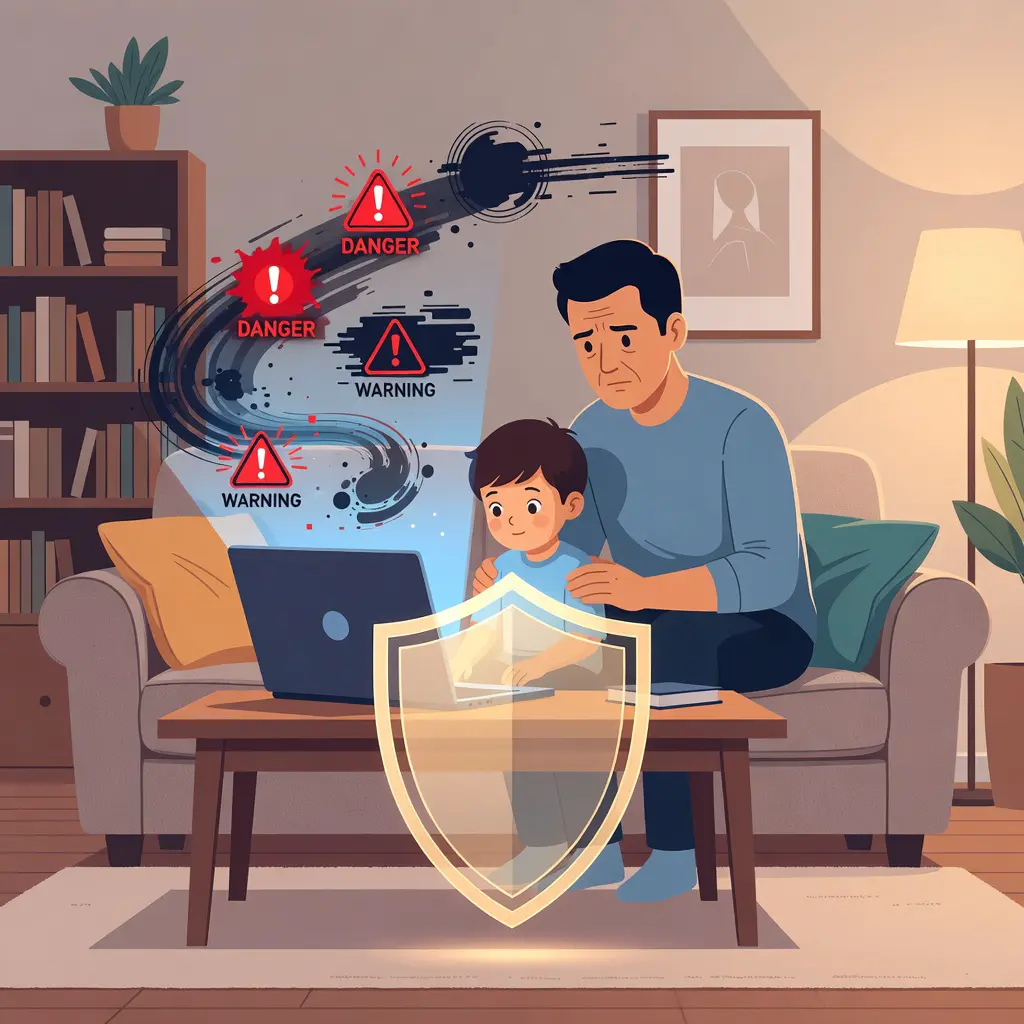
Why Parenting Forums Are Raising Alarms About Casino Review Sites
If you spend any time in online family and parenting communities, you have likely noticed a growing wave of concern about a specific type of website appearing in browser histories, YouTube recommendations, and even app store suggestions aimed at older children. Parents in forums focused on raising children safely are increasingly reporting that their teenagers are stumbling across polished casino review websites — many written in Czech, Slovak, and Polish — that are cleverly designed to lower the psychological barriers to gambling. These platforms look informative and authoritative, but every element is built to recruit future gamblers, not to educate or protect them.
At YesTheyreAllMine, we believe protecting children online is a whole-family conversation, not simply a technical problem solved by a parental filter. The digital landscape today is more complex than most parents realize, and the gambling industry's reach into casual family browsing runs deeper than ever. This guide gives you a clear, actionable framework — one you can work through in five minutes — to identify manipulative casino review pages and safeguard your children before exposure becomes a pattern. Whether your kids are tweens discovering YouTube or teenagers with their own smartphones, the checklist in this article applies directly to your household.

Before we move into the checklist, it is worth understanding exactly what we are dealing with. Many parents assume gambling content online looks like an obvious neon-lit casino lobby — garish and easy to identify. The reality is far more subtle. Casino review sites are designed to mimic legitimate journalism. They feature polished layouts, star ratings, written analyses, and expert recommendations that look indistinguishable from a travel blog or technology comparison site. Most parents walk right past them, and most children never question them at all.
What Makes an Online Casino Review a Digital Trap
The Psychology Behind Review Platforms
The most dangerous casino review sites are not the ones that openly advertise gambling. They are the ones that present themselves as neutral consumer guides. A well-crafted online casino recenze — the Czech word for review — is built on the same psychological architecture as any trusted comparison website: social proof, authority signals, and urgency triggers. The difference is that every element on these pages is engineered to move a reader from curiosity to account registration as efficiently as possible, with profit at every step of that journey.
Children and teenagers are especially vulnerable to social proof mechanics. When they encounter star ratings, user comment sections, and top-ten lists, their brains register this as community validation — the same cognitive shortcut that makes them trust a restaurant with five stars or a mobile game with millions of downloads. Casino review sites exploit this trust system deliberately, and children rarely possess the media literacy to recognize it for what it is.
Key Structural Deceptions Every Parent Should Recognize
Understanding the architecture of these sites makes them far easier to identify at a glance. The table below breaks down the most common deceptive features compared with what a genuinely educational resource looks like:
| Feature | Deceptive Casino Review Site | Legitimate Educational Resource |
|---|---|---|
| Primary call to action | "Claim Your Bonus" / "Play Now" | "Learn More" / "Read the Guide" |
| Age verification | Absent or a trivial checkbox | Not applicable — no gambling links present |
| Affiliate disclosure | Hidden in small footer text | Clear editorial independence statement |
| Bonus language frequency | Prominent and repeated throughout | Not present |
| Responsible gambling section | Buried in footer or absent entirely | Prominently featured if relevant |
| Registration links per page | Multiple, often with countdown timers | None |
A portal like https://czkasino.cz/ represents the type of Czech-language casino review site that regularly surfaces in regional search results and can appear unexpectedly in a teenager's browsing session. When you see domains like this in your router logs or shared browser history, the five-minute checklist below gives you everything you need to assess the risk level immediately.
The 5-Minute Family Safety Checklist
You do not need to be a cybersecurity expert to protect your family from these platforms. This five-step process requires no special tools — only a browser and your own eyes. Running through it once with your child transforms it from a parental inspection into a shared skill they can apply independently for life.
- Identify the primary call to action. Scroll to the very top of any page and locate the most prominent button or banner. If it reads "Register," "Sign Up," "Claim Bonus," or "Play Free," you are on a gambling acquisition site regardless of how neutral the surrounding content appears.
- Search for an affiliate disclosure. Press Ctrl+F and type "affiliate" or "commission." If you find no disclosure at all, or it is buried below the page fold in grey text smaller than the rest of the article, the site is financially incentivised to push users toward registration — a clear sign of compromised objectivity.
- Count the bonus mentions. Using the same search function, count how many times the word "bonus" appears on a single review page. More than five mentions in one article is a strong indicator that the content's true purpose is conversion, not information.
- Check for meaningful age gating. Any responsible platform linking to gambling services must implement genuine age verification. A checkbox reading "I confirm I am 18+" is not meaningful age gating. If there is no verification mechanism, or it can be bypassed in a single click, the site poses a direct and unmitigated risk to any minor who lands on it.
- Assess the responsible gambling section. Search the page for "responsible gambling," "problem gambling," or "GamCare." A legitimate platform will feature a visible, dedicated section on this topic. If it is absent or consists of a single sentence in the site footer, treat the entire platform as a manipulation tool and block it immediately.

Once you have run through all five steps, you have a clear risk classification for any site your child has visited. Sites that fail three or more checks should be added immediately to your router's blocked domain list. For a broader approach to managing screen time and building sustainable digital limits, incorporating this checklist into a weekly review habit is one of the most practical starting points available to any parent today.
This review process becomes significantly more valuable when practiced together with your child from the outset. Research consistently shows that children who learn to recognize persuasive design patterns develop stronger critical thinking skills across all digital contexts, not only in gambling-related situations — and the confidence of being capable of that analysis matters enormously to their long-term digital resilience.
One nuance worth flagging: many Czech-language and Slovak-language casino review sites specifically target Central European audiences with deeply localized content, including information about where to find the best casino bonuses available to users in those regions. These sites are particularly sophisticated because they blend genuine regional cultural content — domestic sports betting, local payment methods, national holidays — with the same conversion-focused architecture as international platforms. Language is no barrier to risk, and familiarity can make these sites feel safer than they are.
Red Flags That Demand Immediate Attention
Beyond the five-minute checklist, there are behavioral and technical warning signs that, if spotted, should prompt a conversation with your child immediately rather than waiting for a scheduled review. These signals indicate a child may already be actively engaging with gambling content rather than passively browsing past it.
- Free-play casino games in the browser history — these are gambling simulations that require no money but condition the brain for gambling behavior through identical psychological reward loops
- Saved passwords or autofill entries with casino domain names, indicating account registration attempts that may have been partially completed
- Search history containing phrases like "casino bonus no deposit," "free spins no verification," or foreign-language equivalents of these terms
- Notifications from unfamiliar apps using card, chip, or dice imagery in their icons and branding
- Conversations with peers referencing specific casino game titles by name, particularly slots, roulette variations, or crash games
- Unusual interest in cryptocurrency or gift card purchasing, which are the most common workarounds used for underage deposits on licensed and unlicensed platforms alike
- Video watch history featuring big win compilations or slot highlights, which function as organic gambling advertising targeted algorithmically at young viewers
When to Escalate Beyond the Home
In most cases, catching exposure early through the checklist is sufficient to prevent lasting harm. However, if your child shows signs of preoccupation with gambling outcomes, expresses genuine distress when unable to access gambling-related content, or if unexplained transactions appear on family accounts, these are indicators that warrant professional support. A conversation with your family doctor or a qualified adolescent counselor is appropriate, and early intervention is dramatically more effective than late-stage treatment. Gambling-related harm in adolescents responds well to early, non-judgmental professional guidance.
Talking to Your Children About Gambling Content Without Panic
One of the most consistent findings from family psychology research is that shame-based conversations about online risk push behavior underground rather than eliminating it. When you discover casino review sites in your child's browsing history, resist the instinct to open with accusations or immediate punishments. Use the discovery as a teaching moment grounded in media literacy and commercial awareness, not moral failure.
Start by asking your child what they thought the site was actually for. Many children who encounter casino review sites genuinely believe they are reading a travel-style guide or a gaming review page. This is not naivety — it is the predictable result of sophisticated design that deliberately blurs those categories. Explaining the affiliate model concretely — the website earns a payment every time someone clicks and registers — is often the single most effective intervention available. Children respond strongly to understanding that they are being financially targeted, not just morally endangered.
Structure the conversation around empowerment rather than prohibition. Teaching your child to run the five-step checklist themselves gives them an active, skilled role in their own safety rather than positioning them as a passive subject of parental surveillance. This approach is more effective and more durable, especially with teenagers who are developmentally oriented toward autonomy. The same principles that help parents reconnect with their kids during difficult conversations apply directly here — calm, curiosity-led dialogue consistently outperforms reactive restriction in building lasting behavioral change.
Age-Appropriate Language for Different Developmental Stages
The conversation should shift significantly depending on your child's age and digital experience. For children aged 8 to 11, focus on the concept of disguised advertising: "this site looks like a review but it is actually an advertisement that pays the person who made it." For tweens aged 12 to 14, introduce the affiliate model and explain how entire sections of the internet are monetized through clicks and registrations. For teenagers aged 15 and older, engage with the actual behavioral science of gambling mechanics — variable reward schedules, loss aversion, and the neurological effects of near-miss events — which are genuinely fascinating to intellectually curious adolescents and provide a powerful rational framework for resisting manipulation that they can carry into adulthood.

The goal is not to make your child afraid of the internet but to make them fluent in its commercial logic. A child who understands that casino review sites are designed to profit from their future gambling behavior is far better protected than one who simply has those sites blocked on a network filter. Filters change, networks change, devices change — but media literacy travels with the child into every environment they encounter for the rest of their life.
Building a Safer Digital Home: Practical Next Steps
The five-minute checklist is a strong foundation, but lasting family digital safety requires a small set of structural habits that become second nature over time. Taken together, the measures below create a layered defense far more effective than any single tool, rule, or piece of software.
- Set up DNS-level filtering through your home router using services like Cloudflare Family or OpenDNS, which block gambling-category domains automatically before they can load on any device connected to your network
- Enable SafeSearch and content restrictions on all search engines and video platforms your children use, including YouTube, Google, and Bing — these settings are free and take under two minutes to activate
- Conduct a monthly browser history review together with your child, framed as a shared learning check-in rather than a surveillance exercise, using the five-step checklist collaboratively
- Discuss the affiliate model at the dinner table so that all children in the household understand the basic concept of paid recommendation content regardless of what specific sites they encounter
- Check app store purchase histories and in-app payment records regularly, as loot boxes and in-game purchasing mechanics are a well-documented behavioral on-ramp to gambling in adolescents
These habits require very little ongoing time once established and provide compounding protection as the digital landscape continues to evolve. The most important quality is consistency: a monthly five-minute review practiced calmly is worth ten times more than an annual deep-dive triggered by a crisis moment.
Conclusion: Five Minutes That Can Change Everything
The world of online casino review platforms — including the growing volume of Czech-language recenze sites targeting Central European and diaspora audiences worldwide — represents a genuine and underappreciated risk to families with children of almost any age. These platforms are not fringe content. They are professionally designed, heavily funded, and specifically engineered to normalize gambling as a leisure activity for the next generation of potential customers. As a parent, you do not need to understand every technical detail of how they work. You need to be able to spot them in five minutes — and now you can.
The key points to carry forward: casino review sites disguise affiliate advertising as neutral journalism; they use the same psychological triggers as trusted consumer comparison platforms; children are particularly susceptible to their social proof mechanics; and the most effective protection combines technological filtering with active media literacy built into your family's regular digital habits. Run the checklist when you see an unfamiliar gambling-adjacent domain. Talk to your children calmly and without shame. Teach them the affiliate model. These three practices, repeated consistently, are among the most powerful tools any parent has in the digital landscape today.
At YesTheyreAllMine, we believe no family should navigate these risks in isolation. Sharing what you learn in parenting communities, school networks, and family forums multiplies your impact — because the more families who recognize these traps, the less effective those traps become. Five minutes of vigilance today is an investment in your child's long-term relationship with money, risk, and digital trust that will pay dividends for years to come.



Comments
Found a Czech "recenze" site in my teen's browser — counting "bonus" mentions (11 on that page) made it obvious it was recruitment, and that fact helped me have a calm, practical talk instead of a lecture.
I found a Czech "recenze" site in my teen's history last week; the affiliate disclosure was tiny and the page kept shouting "bonus." Using the five-minute checklist together made the follow-up talk much calmer and actually helped them spot the tricks.
I found a Czech "recenze" site in my teen's history last week; using the five-minute checklist—searching for repeated "bonus" mentions and spotting the tiny affiliate disclosure—made it clear we had to block it and have a calm conversation.
I never realized how subtle these casino review sites are—my teen thought one was just a regular gaming blog until I ran through the checklist with them.
The “count the bonus mentions” tip surprised me—does that still work if the site uses synonyms like “free spins” or “welcome offer” instead of the word bonus?
The “bonus mentions” tip hit home — my teen showed me a “review” page and the word “bonus” was everywhere, but it looked like a legit tech comparison site. Do you treat “Play free” buttons as just as big a red flag as “Claim bonus”?
The “bonus mentions” trick is eye-opening — my teen clicked a “top 10 casinos” page and the word “bonus” was everywhere. Do you have a quick way to explain affiliate links to kids without making it sound like a lecture?
The point about explaining the affiliate model to kids is something I had never thought of before. My 13-year-old actually got it immediately when I explained that the site earns money every time someone clicks and signs up.
The point about free-play casino games conditioning gambling behavior really stuck with me. My son had a few of those in his history and I genuinely thought they were just regular browser games.
The point about explaining the affiliate model to kids is something I genuinely had not considered before. Told my 13-year-old that the site earns money every time someone clicks and registers, and he immediately got it in a way that blocking websites never achieved.